Yes, you can learn Spanish on your own up to a point — vocabulary, grammar, reading and listening all respond well to solo study. What self-study cannot give you is correction, real interaction, and a syllabus that puts things in the right order. That is why most people who learn entirely alone end up understanding Spanish far better than they can speak it, and why their Spanish often has gaps they cannot see. Whether self-study is enough depends on what you need Spanish for.
📋 Table of Contents
- It depends what you mean by “learning Spanish”
- What self-study does well
- What self-study cannot do
- What we see at the exam centre
- Three kinds of self-study, and they are not the same thing
- Who self-study works for
- Who should not start alone
- How to learn Spanish on your own properly
- Where a course fits
- Frequently asked questions
- Studying on your own?
That is the honest answer, and it is more useful than either of the two things you will usually be told: that apps are all you need, or that you cannot learn anything without a classroom. Both are wrong. Here is where the line actually falls.
It depends what you mean by “learning Spanish”
For other people, choosing to learn Spanish on your own costs more time than it saves:
Most arguments about self-study go nowhere because the two sides mean different things.
If learning Spanish means reading it, understanding it, knowing the grammar and building a large vocabulary, self-study works well. Thousands of people have done exactly that.
If it means holding a conversation at normal speed with someone who is not adjusting their Spanish for you, self-study on its own almost never gets there. Not because learners lack discipline, but because the skill requires something solo study cannot provide: someone responding unpredictably, and someone telling you when you are wrong.
So the useful question is not “does self-study work?” but “which parts of Spanish am I trying to build, and which ones need another person?”
What self-study does well
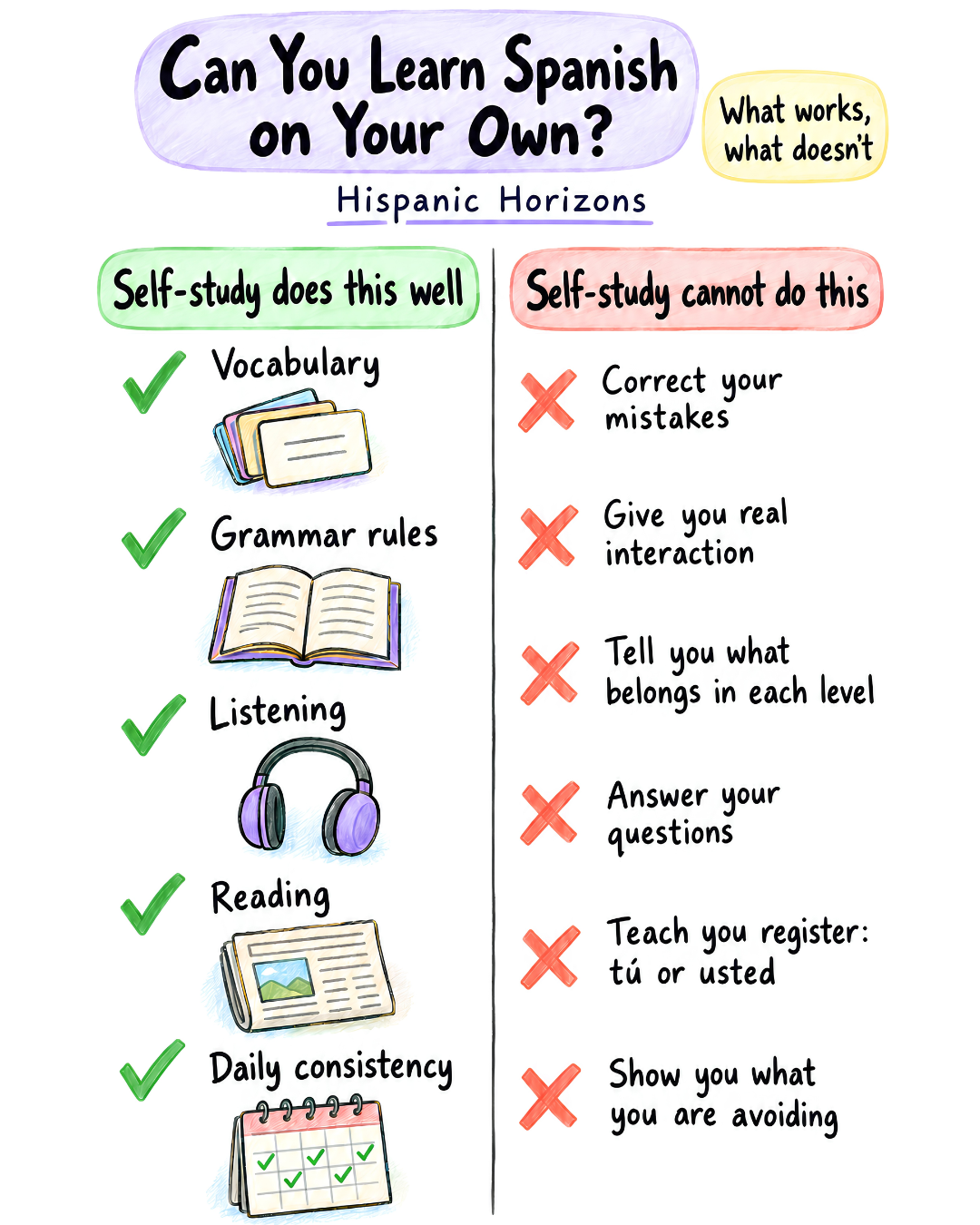
Vocabulary. Spaced repetition on your own beats almost any classroom method. A class cannot drill 2,000 words into you; a well-used flashcard app can.
Grammar rules. Understanding how the subjunctive works, or the difference between por and para, is reading and thinking. You can do that alone, and many learners prefer to, at their own pace.
Listening. Podcasts, series and graded audio are abundant and free. Listening improves steadily with exposure, and exposure is something you control.
Reading. The easiest skill to build alone, and the one that progresses fastest.
Consistency, if you have it. Twenty minutes every day will take you further than a weekly class you half-attend. That part is genuinely in your hands.
What self-study cannot do
It cannot correct you. You will repeat your mistakes confidently, and errors that go uncorrected for months become automatic. Unlearning an automatic error takes far longer than learning it right the first time. It matters most with pronunciation and with the structures English does not have.
It cannot give you real interaction. Producing sentences is not the same as speaking to a person. Real conversation means reacting, interrupting, asking someone to repeat, realising you have been misunderstood and repairing it on the spot. Those are skills of their own, and they only develop when there is somebody on the other side.
It cannot tell you what belongs in each level. This is the one that quietly wastes the most time. Each CEFR level has defined content — which tenses, which structures, which vocabulary, and in what order. A learner working alone has no way of knowing that sequence, so they end up studying the subjunctive before they can handle the past tenses, or memorising vocabulary three levels above anything they can actually use. Everything feels disorganised, and it is — but from the inside it simply feels like Spanish is hard.
It cannot answer your question. When something does not make sense — why ser here and estar there, why that preposition and not the other — a teacher resolves it in thirty seconds. Alone, you either spend an hour in contradictory forums or you move on with the confusion intact and build on top of it.
It cannot teach you register. When to use tú and when usted, what sounds abrupt, what sounds stiff, what a Spanish speaker would actually say rather than what is grammatically possible. Textbooks barely cover it and apps never do, and it is exactly the part that causes problems at work.
It cannot tell you what you are avoiding. Every learner quietly routes around the structures they find hard and builds a comfortable repertoire instead. You cannot see your own avoidance — that is what makes it avoidance.
It cannot tell you where you actually are. Self-assessment is unreliable in both directions. Some learners are convinced they are B1 when they are a solid A2; others undersell themselves for years and sit an exam well below their real level.
It cannot keep you going. There is no class to turn up to and nobody notices when you stop. Most people who abandon Spanish never decide to — they drift, and nothing interrupts the drift.
It cannot certify you. The DELE and the SIELE assess speaking and writing against official scales. You can sit them after studying alone, but preparing for them without feedback from someone who applies those scales is preparing blind.
And AI does not fill the gap. It is the obvious answer — ask a chatbot to correct your Spanish — and it is less reliable than it looks. It will usually spot that something is wrong. The problem is the explanation: the reason it gives is often invented, delivered with complete confidence, and you have no way of telling a correct explanation from a plausible-sounding one. That is precisely the knowledge you do not yet have. It also corrects towards “good Spanish” rather than towards your level, so an A2 text comes back rewritten at B2 and you learn nothing you could produce yourself. Useful for looking a word up. Not a substitute for someone who knows why you made that mistake.
What we see at the exam centre
We are an official DELE and SIELE exam centre, so we meet a lot of candidates who prepared on their own, and the pattern repeats itself.
Their reading is usually fine. Their grammar is often better than they think. Their oral interaction is the weak point, almost every time — and not because they lack vocabulary. It is that they have never had to react: to a question they did not expect, to an examiner who does not slow down, to a conversation that keeps moving while they are still assembling the previous sentence.
That is a skill in itself, it is assessed as such, and it is the one thing you cannot build alone. That is the ceiling when you learn Spanish on your own, and it shows up most clearly in the oral.
Three kinds of self-study, and they are not the same thing
A lot of the confusion comes from treating these as one category. They behave completely differently.
1. Apps and whatever you find online
Duolingo, YouTube, free worksheets, a podcast someone recommended. Zero cost, zero structure.
This is where most people start and where most people stop. It builds vocabulary and a daily habit, which is more than nothing. But there is no sequence, no one checking anything, and nothing telling you what you should be learning next. Progress is real at first and then flattens, usually somewhere around A2, and it is hard to see why from the inside.
2. A structured self-paced course
A real syllabus, in order, with exercises and explanations, built by someone who teaches the language.
This is a different proposition. You still get no correction, but you do get a sequence that was designed rather than improvised, and you know what level you are working towards. Our self-paced Spanish course is this kind — it suits disciplined learners who want to move at their own speed, revise a level, or prepare before joining a live class.
The honest limitation is still the same: it cannot hear you speak.
3. Self-study alongside a class
Not really self-study at all, and the reason it is on this list is that it is what actually works for most people. The class provides correction and speaking time; everything you do between classes provides the hours.
Two or three hours of class a week will not make you fluent on their own. Neither will solo study on its own. Together they do.
Who self-study works for
Learning Spanish on your own works for a recognisable set of people. Be honest with yourself about which of these you are:
- You have learned a language before, so you know what works for you and what a plateau feels like
- You already speak Spanish and want to revise or push a specific skill
- Your goal is reading — academic texts, documents, literature
- You are disciplined in a way you can point to, not a way you hope for
- You have someone to speak to anyway — a partner, a colleague, family — and what you are after is practice rather than correction. A Spanish-speaking friend will keep you talking; they will not tell you why something is wrong, and most are too polite to interrupt and say so.
Who should not start alone
- Complete beginners, in most cases. At A1 you need someone correcting your pronunciation from the first weeks, before the habits set.
- Anyone who needs to speak Spanish for work, where the thing you are being paid for is exactly what solo study does not build.
- Anyone preparing for a certificate, since the DELE and SIELE assess speaking and writing against criteria you cannot apply to yourself.
- Anyone who has already abandoned an app more than once. That is not a character flaw, it is information: you need the structure and the appointment.
How to learn Spanish on your own properly
If you are going to do it alone, do it well:
- Pick one structured source and finish it. Jumping between resources feels productive and is the most common way people stall.
- Know what level you are working towards. Our guide to the Spanish language levels explains what A1 to C2 actually mean, so “getting better” becomes something you can measure.
- Speak out loud from the first week, even alone. Our guide on how to practise speaking Spanish covers the methods that work without a partner.
- Get corrected periodically, even if not weekly. A conversation class once a month catches errors before they set.
- Put a date on it. An exam, a trip, a conversation you have promised yourself. Self-study without a deadline drifts.
Where a course fits
If self-study is working for you, keep going. This is not an argument that everyone needs a classroom. None of this means you should not learn Spanish on your own — only that it works best when something else covers what it cannot.
But if you have been studying alone for months and your Spanish has stopped moving, the problem is usually not effort and not the app. It is that nobody has heard you speak. Our live online Spanish classes run from A1 to C2 with a maximum of 15 students, so you speak in every session and a qualified teacher corrects you as you do.
Many of our students combine both: the course for structure and correction, their own study for the hours in between. If you are weighing up formats, our comparison of live online vs in-person classes covers which one fits a working schedule.
Frequently asked questions
Can you become fluent in Spanish by yourself?
You can reach a high level of reading, listening and grammar alone. Fluency in speaking is harder, because it depends on responding to other people in real time and on being corrected. Most learners who study entirely alone understand far more than they can say.
How long does it take to learn Spanish on your own?
Longer than with a teacher, mostly because uncorrected errors slow you down and because nobody is deciding what you work on next. The hours matter less than whether anyone is checking them.
Is a self-paced course better than an app?
Yes, for anything beyond vocabulary. An app gives you exercises; a course gives you a sequence designed by someone who teaches the language, so you know what you are building and in what order.
Can I take the DELE if I studied Spanish on my own?
Yes. How you learned does not affect your eligibility. But the speaking and writing papers are marked against official scales, and preparing for those without feedback from someone who applies them is the main reason self-taught candidates underperform.
What is the biggest mistake self-taught learners make?
Never speaking out loud. Reading, listening and grammar exercises all feel like progress, and they are — but they build the wrong skill if your goal is conversation.
Should I study alone first and take classes later?
It works, and it is a common route. Just do not leave speaking until the end: by then the pronunciation habits are set and they take longer to undo than they would have taken to learn correctly.
Studying on your own?
Tell us where you are and what you are aiming for, and we will tell you honestly whether you need a class or just a better structure.
Self-paced Spanish course · Live online Spanish classes · Book a trial class