The Spanish language levels follow the CEFR framework — six levels from A1 (complete beginner) to C2 (mastery). Knowing your level helps you choose the right course, set realistic goals, and decide which DELE exam to take. This guide explains what each level means, how long it takes to reach it, and what you can actually do with your Spanish at each stage.
📋 Table of Contents
What Is the CEFR? Spanish language levels explained
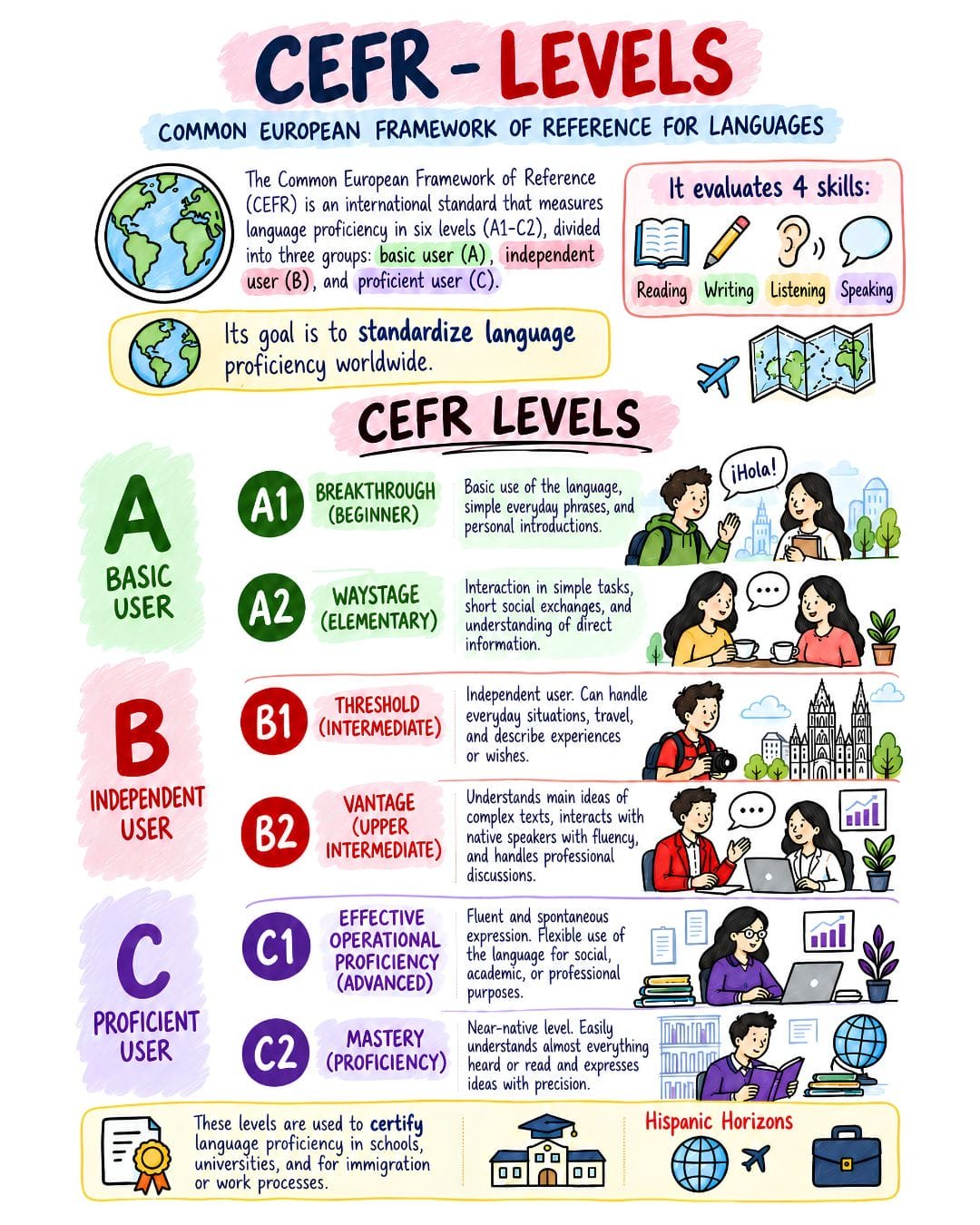
The Common European Framework of Reference for Languages (CEFR) or MCER in Spanish, is the international standard used to measure language ability. It was developed by the Council of Europe and is recognised by universities, employers, and language schools worldwide.
The CEFR divides language learning into three broad bands, each containing two levels:
- A — Basic User: A1 (Beginner) and A2 (Elementary)
- B — Independent User: B1 (Intermediate) and B2 (Upper-Intermediate)
- C — Proficient User: C1 (Advanced) and C2 (Mastery)
Every Spanish language course at a reputable school like Hispanic Horizons should be aligned to these levels. If you are not sure where you stand, a placement test is the fastest way to find out.
A1 — Beginner Spanish
What you can do at A1: Introduce yourself, ask and answer simple questions about familiar topics (your name, where you are from, what you do), and understand basic phrases when people speak slowly and clearly.
What you learn at A1
At this level, you build the foundation of Spanish: the alphabet and pronunciation, numbers, greetings, and the essential grammar structures such as the verb ser (to be), tener (to have), and regular present-tense verbs. You start working with everyday vocabulary around family, food, colours, and daily routines.
How long does A1 take?
Reaching A1 takes approximately 60–80 hours of guided study. With two or three classes per week, most students complete A1 in two to three months.
DELE exam at A1
The DELE A1 exam (and the DELE A1 Escolar for school-age students) certifies this level. It is the entry point for formal Spanish certification recognised by the Instituto Cervantes and universities worldwide.
A2 — Elementary Spanish
What you can do at A2: Handle simple transactions (shopping, ordering in a restaurant, asking for directions), talk about your daily routine, describe past events in basic terms, and understand frequently used expressions in familiar contexts.
What you learn at A2
A2 introduces the past tense (pretérito indefinido and pretérito perfecto), adjective agreement, more complex sentence structures, and a wider range of vocabulary including travel, health, and work. You start having short conversations on predictable topics.
How long does A2 take?
Studying A2 takes approximately 130–150 hours of study.
DELE exam at A2
The DELE A2 is the right certification for elementary speakers. It is widely recognised and a solid first credential for anyone learning Spanish for travel or early career purposes.
B1 — Intermediate Spanish
What you can do at B1: Understand the main points of clear standard speech on familiar matters, handle most travel situations, produce simple connected text on familiar topics, and describe experiences, events, and aspirations.
What you learn at B1
B1 is where Spanish starts to feel real. You work with the subjunctive mood (one of the most important structures in Spanish), compound tenses, relative clauses, and a much richer vocabulary. You can follow conversations at normal speed, though you may miss some nuance.
How long does B1 take?
Approximately 140–150 hours of study. B1 is the level most commonly set as a minimum requirement for university exchange programmes in Spain and Latin America.
DELE exam at B1
The DELE B1 certifies independent language use. It is a practical and achievable target for learners who have been studying consistently for several months.
B2 — Upper-Intermediate Spanish
What you can do at B2: Understand the main ideas of complex text on both concrete and abstract topics, interact with native speakers with a reasonable degree of fluency, and produce clear, detailed text on a wide range of subjects.
What you learn at B2
B2 covers advanced grammar including the full subjunctive system, conditional tenses, passive voice, and complex connecting expressions. Your vocabulary expands significantly into professional, academic, and cultural domains. This is the level at which most people can work or study in a Spanish-speaking environment.
How long does B2 take?
Approximately 150–160 hours of study, you need to reach B2 after completing B1. This is commonly cited as the benchmark for functional professional fluency.
DELE exam at B2
The DELE B2 is one of the most requested certifications for professional and academic purposes. It is recognised by many Spanish companies, universities, and immigration authorities. At Hispanic Horizons, our students have a 99% pass rate in DELE exams — a result of our official DELE examiner-taught preparation courses.
C1 — Advanced Spanish
What you can do at C1: Express yourself fluently and spontaneously, use language flexibly and effectively for social, academic, and professional purposes, and produce clear, well-structured text on complex subjects.
What you learn at C1
C1 focuses on precision, register, and nuance. You study advanced idiomatic expressions, complex subordinate clauses, stylistic variation across formal and informal registers, and the subtle differences between near-synonyms. At C1, you can read literature, watch films without subtitles, and participate in professional meetings entirely in Spanish.
How long does C1 take?
From B2, approximately you will need 160–170 hours of study to reach C1. Most learners who reach C1 have spent sustained, focused time on the language — ideally including immersion or professional use of Spanish.
DELE exam at C1
The DELE C1 is the advanced certification. It is widely required for academic programmes taught in Spanish and for professional positions in Spanish-speaking organisations.
C2 — Mastery
What you can do at C2: Understand virtually everything you hear or read, summarise information from different spoken and written sources, and express yourself with the highest degree of precision and fluency on any topic.
What you learn at C2
C2 is not about learning new grammar — it is about achieving the precision, sophistication, and cultural depth of an educated native speaker. The focus shifts to stylistics, rhetoric, and the kind of nuanced language use found in literature, academia, and high-level professional contexts.
How long does C2 take?
From C1, you will need approximately 170–180 hours of study to reach C2, although sometimes you need many more hours. Many learners take a long time to reach C2, and some never formally pursue this level — B2 or C1 is sufficient for most professional and academic goals.
DELE exam at C2
The DELE C2 — also known as the Diploma de Español — Maestría — is the highest level of Spanish certification. It is the equivalent of near-native proficiency and is recognised globally as the gold standard of Spanish language qualifications.
Spanish Language Levels at a Glance
| Level | Name | What you can do | Study hours | DELE exam |
|---|---|---|---|---|
| A1 | Beginner | Basic introductions and simple questions | 60–80 h | DELE A1 |
| A2 | Elementary | Everyday transactions and familiar topics | 130–150 h | DELE A2 |
| B1 | Intermediate | Travel, describe experiences, main ideas of standard speech | 140-150 h | DELE B1 |
| B2 | Upper-Intermediate | Professional and academic communication | 150-160 h | DELE B2 |
| C1 | Advanced | Fluent, flexible, effective communication | 160-170 h | DELE C1 |
| C2 | Mastery | Near-native precision and fluency | 170-180 h | DELE C2 |
Which Spanish Level Should You Aim For?
The right target depends on your goal:
- For travel and everyday communication — A2 or B1 is perfectly functional, and if you are fitting study around an unpredictable week, a self-paced Spanish course covers these levels at your own speed. You can navigate most situations abroad, make friends, and enjoy the experience of speaking Spanish.
- For work and business — B2 is the standard most employers and multinational companies look for, particularly for roles involving Spanish-speaking clients or markets in Latin America and Spain.
- For study in a Spanish-speaking country — Most universities in Spain and Latin America require B2 as a minimum. C1 is preferred for competitive programmes.
- For professional certification — The DELE exam certifies your level officially, and the SIELE exam scores you from A1 to C1 on a scale if you need a result in weeks rather than months. A recognised certificate strengthens your CV and provides proof of ability that self-assessment cannot.
Which DELE Exam Should You Take?
If you are not sure which DELE level is right for you, the best approach is to take a free placement test first. At Hispanic Horizons, we offer a placement assessment as part of our enrolment process.
As an Instituto Cervantes-accredited centre in India and the DELE exam centre in Mumbai, Hispanic Horizons offers preparation courses for all DELE levels — A1 to C2 — both in person in Mumbai and online worldwide.
Our DELE preparation courses are taught by certified DELE examiners who know the exam format, the marking criteria, and the most common mistakes candidates make at each level.
Frequently Asked Questions About Spanish Language Levels
What are the 6 Spanish language levels?
The six levels are A1 (Beginner), A2 (Elementary), B1 (Intermediate), B2 (Upper-Intermediate), C1 (Advanced), and C2 (Mastery). They are defined by the Common European Framework of Reference for Languages (CEFR).
What level of Spanish is considered fluent?
B2 is generally considered working fluency — you can communicate effectively in professional and social contexts. C1 is full professional fluency, and C2 is near-native mastery.
What is the difference between B1 and B2 Spanish?
At B1 you can handle familiar situations and everyday topics. At B2 you can understand complex texts, discuss abstract subjects, and communicate with native speakers without significant effort. B2 requires only a little more study time than B1, but a significant jump in linguistic depth and complexity.
Which DELE exam is best for a beginner?
The DELE A1 is the starting point for beginners. If you have some basic knowledge already, a placement test can confirm whether you are ready for A2 or B1 instead.
Can I learn Spanish online and still take the DELE exam?
Yes. You can take live online Spanish classes and then sit for the DELE exam at an official exam centre. Hispanic Horizons offers online Spanish courses and is the DELE exam centre in Mumbai, India.
Is Spanish useful for jobs in India?
Yes — demand for Spanish speakers in India is growing steadily, particularly in sectors like IT, BPO, manufacturing, and international trade with Latin America and Spain. B2 level is the most commonly requested by employers.
Start Learning Spanish at the Right Level
Whether you are a complete beginner or looking to push from B1 to B2, the most important step is knowing where you are starting from. Take a free Spanish level test and book a trial class with our expert teachers at Hispanic Horizons — Instituto Cervantes-accredited Spanish institute.
Once you know your level, the next question is usually how to study. If you are weighing up classes at a centre against studying from home, our guide to live online vs in-person Spanish classes walks through which format suits a working schedule and our guide to choosing Spanish classes in India walks through every option.
At Hispanic Horizons, an Instituto Cervantes Accredited Centre in Mumbai and DELE exam centre in Mumbai, our Spanish courses take you from A1 to C2 — in-person in Bandra West or online from anywhere in India.