
To prepare for the DELE, start by understanding how it is scored: the four papers are grouped in two, and you need at least 30 out of 50 in each group to pass. Then choose your level honestly, work on all four skills rather than your strongest, and practise with official past papers under exam conditions.
Most candidates who fail the DELE do not fail because their Spanish is weak. They fail because they prepared for the wrong thing. This guide explains how the exam actually works and how to build a preparation plan around it.
📋 Table of Contents
- Understand the scoring before you study anything
- Choose the right level
- Give yourself enough time
- How to prepare each paper
- Use the official materials to prepare for DELE
- The mistakes that cost the diploma
- Preparing for the DELE exam in India
- Frequently asked questions
- Prepare with an official DELE exam centre
1. Understand the scoring before you study anything
This is where most preparation goes wrong, so it comes first.
The DELE A1 to C1 has four papers. For scoring purposes they are combined into two groups:
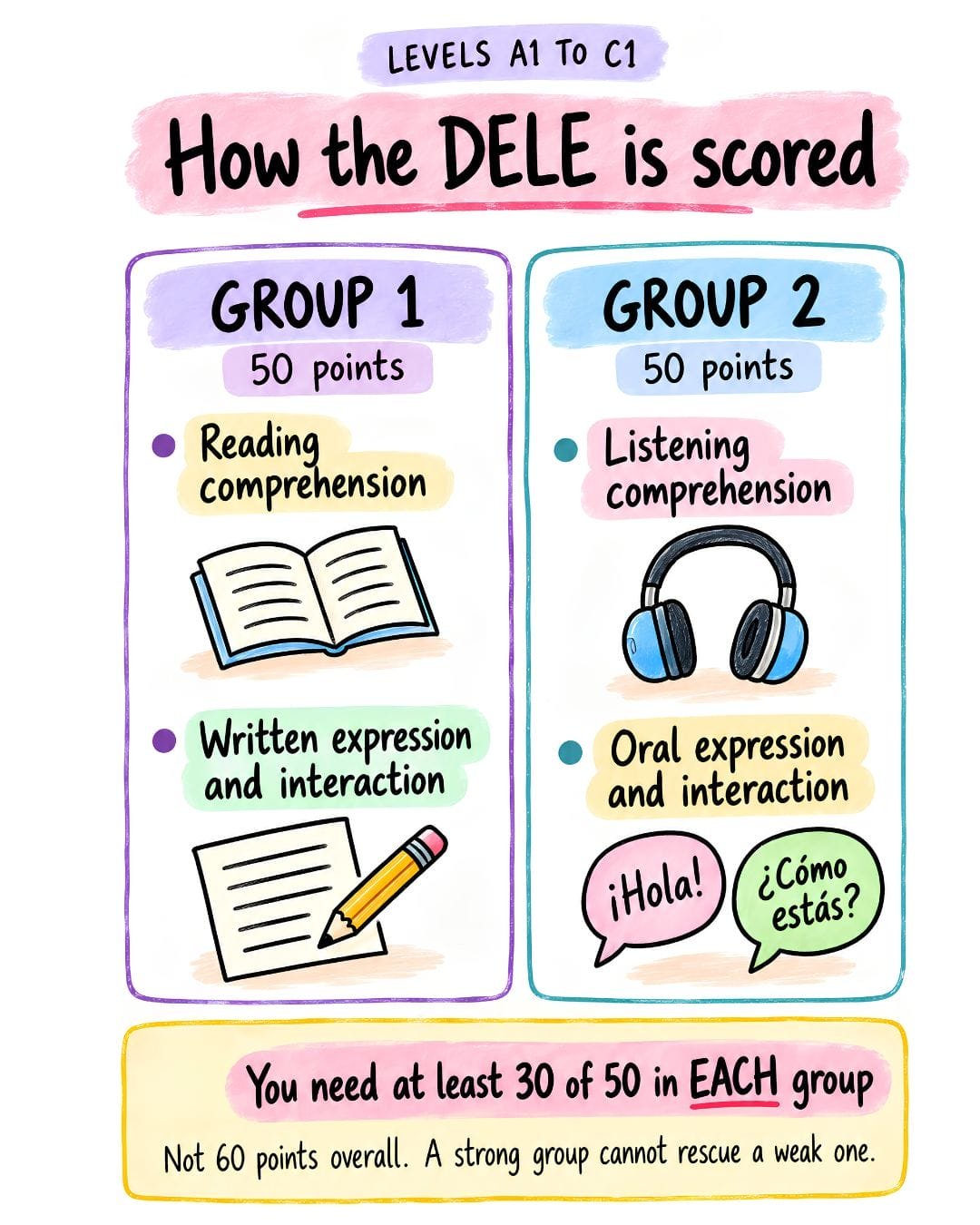
Each group is worth 50 points, for a maximum of 100. To be awarded apto (pass), you need a minimum of 30 points in each group — not 60 points overall.
That distinction decides who passes. A candidate scoring 48 in Group 1 and 28 in Group 2 has 76 points out of 100 and still fails. The strong reading and writing cannot compensate for the weak listening and speaking.
The practical consequence: preparation time should go to your weakest group, not your strongest. Most candidates do the opposite, because practising what you are good at feels productive.
The C2 exception
The DELE C2 works differently. It is organised into three integrated papers rather than four separate ones, and you need a minimum score in each of the three to pass. The principle is the same, only stricter: there is nowhere to hide a weak skill.
2. Choose the right level
Registering for the wrong level is the second most common reason for failure, and it is entirely avoidable.
Two errors to watch for:
- Registering too high because you need a certain level for a job or a university, rather than because you are at it. The exam does not award a lower level as a consolation. You either pass the level you registered for or you get nothing.
- Registering too low to be safe, and wasting a session and a fee on a diploma that does not meet the requirement you actually have.
If you are not certain where you stand, read our guide to the Spanish language levels from A1 to C2 and take a placement assessment before you register. It costs nothing and it prevents both mistakes.
If your deadline is tight and you are genuinely unsure of your level, it is worth reading our comparison of DELE vs SIELE — the SIELE tells you your level rather than testing you against one, which removes the risk.
3. Give yourself enough time
There is no universal answer, but there is a useful way to think about it.
If you are already comfortably at the level: three to four months of focused preparation is usually enough. Your Spanish is not the issue; exam technique is.
If you are at the level but not solidly: six months, and expect to keep studying the language itself alongside exam practice.
If you are still working towards the level: do not register yet. Reach the level first, then prepare for the exam. Compressing both into one timeline is how candidates end up sitting an exam they were never going to pass.
Because DELE registration closes well before the exam date and results take around two to three months, count on roughly six months from decision to diploma. Check the current session dates and deadlines on our DELE exams page.
4. How to prepare each paper
Reading comprehension
The difficulty is rarely vocabulary. It is time and text type. The exam uses a range of real-world text types — notices, articles, correspondence, opinion pieces — and each has its own conventions.
- Practise with a timer from the beginning, not just in the final weeks
- Learn to identify what a question is really asking before rereading the text
- Do not translate mentally; at B1 and above there is not enough time
Listening comprehension
The paper most candidates underestimate, and the one that most often sinks Group 2.
- From B1 upwards the exam includes the main varieties of Spanish, not only Castilian. If you have only ever listened to one accent, that is a gap to close deliberately.
- Practise with audio played once, as in the exam, rather than replaying until you understand
- Train on natural speed audio, not slowed learner recordings
Written expression and interaction
The single most avoidable loss of points.
- Follow the instructions exactly. The task specifies a text type, a set of content points and a word count. A well-written text that ignores one of the content points, or falls outside the word range, loses marks that have nothing to do with your Spanish.
- Plan before writing. Two minutes of structure saves more marks than ten minutes of correction.
- Write full practice texts under time pressure and have them corrected by someone who knows the assessment criteria. Self-correction does not work here — you cannot see your own blind spots.
Oral expression and interaction
The paper candidates fear most, and the one where preparation pays off fastest.
- You get preparation time before the oral, and how you use it matters. Practise using exactly that amount of time, not more.
- Fluency counts for more than perfection. Hesitating to search for the perfect word costs you more than a small grammatical error.
- Rehearse with a real person, ideally someone trained in the assessment scales. Speaking to yourself does not reproduce the pressure of an examiner across the table.
- Between sessions, the techniques in our guide to how to practice Spanish speaking — recording yourself, shadowing, answering questions aloud against the clock — are directly useful for the oral paper.
5. Use the official materials to prepare for DELE
The Instituto Cervantes publishes everything you need to practise, free, on its DELE preparation page. Three things there are worth your time, and they are not the same thing:
Past exam papers (modelos de examen). Complete papers from previous sessions for every level from A1 to C2, with the audio files for the listening tasks and the answer keys for reading and listening. Use these for full mock exams under real conditions — full timing, no dictionary, no pauses, all four papers in sequence. Doing isolated exercises tells you very little about how you will perform across a three-hour exam.
The official exam guides (guías de examen). One per level, and the most underused resource of the three. They set out the structure task by task, the scoring system, and — most importantly — the assessment scales used to mark the writing and speaking papers, with real samples of candidate work and the marks each received. If you read only one document before your exam, read the guide for your level. Knowing exactly what your examiner is looking for changes how you write and how you speak.
Answer sheet templates (hojas de respuesta). Worth ten minutes the week before the exam. Transferring answers to an unfamiliar sheet under time pressure costs marks that have nothing to do with your Spanish.
The materials are published in Spanish. If your level is A1 or A2, working through them with a structured Spanish course is more productive than trying to decode the instructions alone.
6. The mistakes that cost the diploma
From what we see as an exam centre, these come up again and again:
- Preparing only the strong skills. Covered above, and the most common of all.
- Ignoring the word count in the writing task.
- Never practising the oral out loud. Reading about the oral is not preparing for it.
- Registering for a level to meet an external requirement rather than the level you are at.
- Leaving the listening paper until the end of the preparation period.
- Doing exercises but never a full mock exam, so exam-day stamina and timing are untested.
7. Preparing for the DELE exam in India
Hispanic Horizons is an official DELE exam centre in Mumbai, which means you can prepare and sit the exam in the same place.
Our DELE preparation courses cover every level from A1 to C2 and are taught by certified DELE examiners. That matters most for the writing and oral papers: someone who has applied the official assessment scales can tell you where your text or your performance sits on them, which is not something you can work out alone or from a textbook.
Courses run online as well as in person, so you can prepare from anywhere and travel to a centre only for the exam itself. If you are still building your level rather than preparing for the exam, our live online Spanish classes follow the CEFR from A1 to C2.
Frequently asked questions
How long does it take to prepare for the DELE?
If you are already at the level, three to four months of focused work is usually enough. If you are close but not solid, allow six months. If you are not yet at the level, reach it first — exam preparation cannot substitute for the language itself.
Can I fail the DELE even with a good total score?
Yes. You need at least 30 out of 50 in each of the two scoring groups. A high total with one weak group results in no apto, so a candidate can score well overall and still not receive the diploma.
Do I need a preparation course to pass the DELE?
No, and candidates do pass on self-study. A self-paced Spanish course can carry the language side while you work on exam technique. But the writing and oral papers are assessed against official scales, and those are difficult to prepare for without feedback from someone who applies them. That is where a course makes the clearest difference.
What happens if I fail?
Nothing is carried over. You can register again for the next session, at the same level or a different one, and you sit the complete exam again. There is no limit on attempts.
Can I prepare for the DELE online and sit the exam in person?
Yes. The DELE is a paper-based exam taken at an official centre, but preparation can be entirely online. Many of our candidates prepare remotely and come to Mumbai only for the exam.
Which is easier, the DELE or the SIELE?
Neither is easier — they measure the same thing differently. The DELE tests you against one level and you can fail it; the SIELE places you on a scale. Our DELE vs SIELE comparison explains which fits which situation.
Prepare with an official DELE exam centre
Preparation works best when it starts from an honest picture of where you are. Talk to us: we will assess your level, tell you which DELE level you should register for, and build a plan around your exam date.
DELE preparation courses · DELE exam dates and fees in Mumbai · Book a trial class