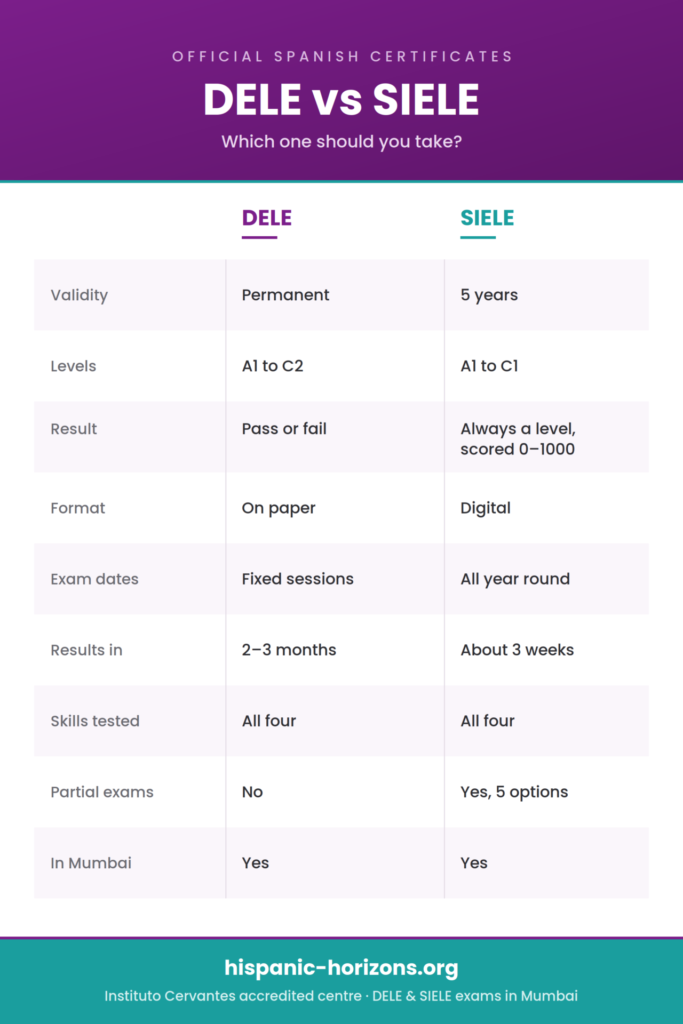
The DELE is a permanent diploma that certifies one specific CEFR level and is taken on fixed dates. The SIELE is a digital certificate valid for five years that scores your Spanish from 0 to 1000 across A1–C1, and can be booked almost any day. Choose the DELE for permanent proof, the SIELE for speed and flexibility.
Both are official. Both are backed by the Instituto Cervantes. Neither is “better” in the abstract — the right one depends entirely on what you need the certificate for. This guide explains the real differences and helps you decide.
DELE vs SIELE at a glance
| DELE | SIELE | |
|---|---|---|
| Full name | Diploma de Español como Lengua Extranjera | Servicio Internacional de Evaluación de la Lengua Española |
| Validity | Permanent, never expires | 5 years |
| Levels | A1 to C2 | A1 to C1 (scored 0–1000) |
| Result | Pass or fail at one level | Always a score — the certificate shows the level reached in each skill, plus an overall level |
| Format | Paper-based, at an exam centre | Digital, at an exam centre |
| Dates | Fixed exam sessions per year | Available dates throughout the year or book a date that suits you |
| Results in | Around 2–3 months | Around 3 weeks |
| Skills tested | Reading, listening, writing, speaking | Reading, listening, writing, speaking |
| Partial exams | No | Yes — five independent modalities |
| Available in Mumbai | Yes | Yes |
What is DELE?
The DELE is the official diploma issued by the Instituto Cervantes on behalf of Spain’s Ministry of Education. It has been the reference certificate for Spanish since 1988 and is recognised by universities, employers and government bodies worldwide.
You register for one specific level — A1, A2, B1, B2, C1 or C2 — and sit the exam for that level. There are four papers: reading, listening, writing and speaking. To pass, you need to reach the minimum score in each group of tests, not just a good average. Miss the minimum in one group and you do not get the diploma, regardless of how well you did elsewhere.
The result is binary: apto (pass) or no apto (fail). If you pass, the diploma is yours for life. It never expires and never needs renewing.
The DELE is taken on paper, at an official exam centre, on fixed dates set by the Instituto Cervantes each year. Registration closes weeks before the exam, so planning matters.
What is SIELE?
The SIELE was launched in 2016 and is promoted by four institutions: the Instituto Cervantes, the Universidad Nacional Autónoma de México, the Universidad de Salamanca and the Universidad de Buenos Aires. It was designed to be faster and more flexible than the DELE.
It works differently in a fundamental way. You do not register for a level. You sit one single multilevel exam, and the exam tells you what level you are at. Each of the four skills is scored separately out of 250, giving a total between 0 and 1000, with each score mapped to a CEFR level from A1 to C1.
This means you cannot fail the SIELE. You always receive a certificate; the question is only what level it shows. It also means your certificate can show different levels for different skills — B2 in listening and B1 in writing, for example. That is a realistic picture of most learners.
The SIELE is entirely digital and the certificate is valid for five years.
The five independent modalities
Besides the complete exam (SIELE Global), you can take partial versions if you only need to certify certain skills:
- S1 — reading and listening
- S2 — reading and writing
- S3 — listening and speaking
- S4 — speaking only
- S5 — writing and speaking
These produce a report rather than a full certificate, also valid for five years. Useful if a specific employer or programme only asks for evidence of, say, spoken Spanish.
The five differences that actually matter
1. Permanent vs five years
This is the big one. A DELE diploma is yours forever. A SIELE certificate expires after five years and you would need to sit the exam again.
If you are building a CV that you will use for decades, the DELE is the better investment. If you need proof of your current level for an application happening now, five years is more than enough and the expiry is irrelevant.
2. You can fail the DELE
The DELE is a pass/fail exam. Fail one group of tests and you lose the whole diploma for that session, and you have to sit the entire exam again at the next session.
The SIELE removes that risk completely. Whatever your level, you get a certificate reflecting it. For candidates who are unsure whether they are solidly at a level, this is a meaningful difference — and it is why many learners who are borderline between B1 and B2 choose the SIELE.
3. Dates and waiting time
The DELE runs on fixed sessions with registration deadlines months in advance, and results take around two to three months. From decision to diploma in hand, you should count on the better part of six months.
The SIELE can usually be booked for a date that suits you, and results arrive in about three weeks. If you have a deadline — a job application, a university admission, a visa file — this difference can decide the choice for you.
4. C2 exists only in the DELE
The SIELE certifies up to C1. If you need certified C2 — the highest level, near-native mastery — the DELE is your only option.
5. Some institutions and official procedures accept only the DELE
Certain administrative processes, most notably Spanish nationality applications, specify the DELE and do not accept the SIELE. Some universities and institutions also ask for the DELE by name rather than accepting any official certificate. If your certificate is for a specific application — an official procedure, a university admission, a scholarship — check the exact requirement before you register. Do not assume the two are interchangeable.
Which one should you take?
Take the DELE if:
- You want permanent proof of your Spanish that you will never have to renew
- You need C2
- Your employer, university or immigration process specifically names the DELE
- You are confident you are solidly at the level you are registering for
- You have time to plan around the exam calendar
Take the SIELE if:
- You have a deadline in the next few weeks or months
- You are not sure exactly which level you are at
- You want to avoid the risk of failing a specific level and having to start over
- Your Spanish is uneven across skills and you want that reflected honestly
- You only need to certify certain skills, not all four
A practical middle path: some learners take the SIELE first to get an accurate, fast reading of where they stand, then prepare for and take the DELE at the level the SIELE confirmed. It costs more, but it removes almost all the uncertainty from the DELE attempt.
If you are unsure what level you are at before deciding anything, start with our guide to the Spanish language levels from A1 to C2.
Taking the DELE or the SIELE in India
Hispanic Horizons in Mumbai is an official exam centre for both. That means you can sit either exam with us, and prepare for either exam with us.
- DELE — we run the official exam sessions in Mumbai. Dates, levels offered and fees are on our DELE exams page.
- SIELE — because the SIELE is digital and appointment-based, you can sit it at our centre on the scheduled dates, and we can also arrange additional dates on request. Details on our SIELE page.
For preparation, our DELE preparation courses cover every level from A1 to C2 and are taught by certified DELE examiners who know the marking criteria from the inside. We also prepare candidates for the SIELE on request.
Frequently asked questions
Is the SIELE as recognised as the DELE?
Both are official and both are backed by the Instituto Cervantes. The DELE has been established for longer and is the one named in certain official procedures. For most academic and professional purposes, both are accepted. When it matters, check what the specific institution asks for.
Can I fail the SIELE?
The SIELE always produces a certificate showing the level you reached in each of the four skills, plus an overall level and a score out of 1000. There is no pass or fail — the exam simply tells you where you are.
Which is cheaper, the DELE or the SIELE?
It depends on the level and the modality. DELE fees rise with the level; SIELE fees depend on whether you take the complete exam or a partial modality. Current fees for both in India are on our DELE and SIELE pages.
Do I need to take a course before the exam?
No, you can register directly for either exam. But both test all four skills under time pressure, and the DELE in particular has a format that rewards familiarity. Candidates who prepare with an official exam centre generally perform better, especially in the speaking and writing papers.
Which exam is better for a job in India?
For most roles, either works. Employers in India hiring Spanish speakers — in IT, BPO, manufacturing and trade with Latin America and Spain — usually ask for a B2 level rather than a specific certificate. If you expect to reuse the certificate over many years, the permanent DELE is the safer choice.
Can I take the DELE or SIELE if I studied Spanish online?
Yes. How you learned does not affect your eligibility. You can take Spanish classes online from anywhere and then sit either exam at an official centre.
Not sure which exam is right for you?
Choosing between the DELE and the SIELE is easier once you know your actual level and your deadline. Talk to us — we are an Instituto Cervantes accredited centre and an official exam centre for both exams in Mumbai, and we will tell you honestly which one fits your situation.
Book a trial class · Explore our Spanish courses · DELE exam preparation
Comparison between the DELE and SIELE official Spanish exams