You can make real progress speaking Spanish between your classes. Shadowing, recording yourself, narrating your day and reading aloud are all good ways to practice Spanish speaking without a partner. What solo practice cannot give you is correction and unpredictability — so use it to build confidence and automatic speech, and get feedback from a teacher every week.
Speaking is the skill that lags behind for almost every learner, and the reason is simple: it is the only one you cannot do quietly by yourself on a train. Reading, listening and writing are all solo activities. Speaking seems to require another person.
It mostly does not. Here is what works, and where it stops working.
📋 Table of Contents
- Why speaking lags behind, and why practice matters
- How to practice Spanish speaking: five methods that work alone
- Two things that involve other people, sort of
- What solo practice cannot do
- When you need a teacher, not more practice
- A weekly routine that works
- Common mistakes
- Frequently asked questions about how to practice Spanish speaking
- Get the part you can’t do alone
Why speaking lags behind, and why practice matters
Most learners are noticeably better at understanding Spanish than at producing it. That gap is normal and it has a mechanical cause: you have done hundreds of hours of input and very few of output.
Speaking requires you to retrieve a word, choose a structure, conjugate a verb and produce the sounds — all within about a second. Recognising the same sentence when someone else says it needs none of that. The only way to close the gap is to practise the retrieval itself, and that is something you can do between classes.
How to practice Spanish speaking: five methods that work alone
1. Shadowing
Play a short audio clip of natural Spanish and speak along with it, a beat behind, copying the rhythm and intonation rather than translating.
Start with 30 seconds and repeat the same clip until you can keep up. It feels strange for the first week and then it works: shadowing trains your mouth to produce Spanish sounds at Spanish speed, which is the physical bottleneck most learners never address.
Use audio at your level — our Spanish audio series by level is a good place to start. Shadowing a C1 podcast at A2 teaches you nothing except frustration.
2. Record yourself and listen back
Pick a topic — your weekend, your job, a film you saw — and speak for two minutes into your phone. Then listen.
This is uncomfortable and it is the single most efficient solo technique, because you catch things nobody would ever tell you: the filler sounds, the repeated structure, the words you avoid, the places where you slow down. Keep the recordings. Comparing month one with month four is the clearest evidence of progress you will get.
3. Narrate your day
Describe what you are doing, in Spanish, as you do it. Making tea, walking to the station, waiting for a meeting to start.
It sounds trivial. It is not: it forces you to notice which everyday words you do not have, which is exactly the vocabulary you most need. Keep a note of the gaps and take them to your next class.
4. Read aloud
Take a text at your level and read it out loud, slowly, paying attention to the sounds rather than the meaning.
This does not build spontaneity, so it is not enough on its own. But it does build pronunciation and confidence with longer sentences, and it is the easiest of these methods to start with if speaking makes you nervous.
5. Answer questions out loud
Find a list of everyday questions — what did you do yesterday, what are your plans, describe your family — and answer them aloud, without writing anything first.
Time yourself. A minute per answer. The point is not to be correct; the point is to keep going without stopping to plan, because stopping to plan is what makes conversation with a real person collapse.
Two things that involve other people, sort of
Voice notes
If you have any contact who speaks Spanish, voice notes are the most underrated tool available. They are asynchronous, so no pressure and no scheduling, but they are real communication with a real person who will answer.
Language exchange apps
They can complement your learning, but they are not a way to learn. Your exchange partner is not a teacher: they can tell you something sounds wrong, but usually not why or what to do instead, and most native speakers are polite enough to let errors pass rather than interrupt. Half the session also goes on your own language rather than theirs.
Treat them as extra speaking time once you already have a structure in place. If you are relying on an app as your main source of Spanish, that is why progress feels slow.
What solo practice cannot do
This is the part most articles on this topic leave out, so it is worth saying plainly.
It cannot correct you. You will repeat your mistakes fluently. Errors that go uncorrected for months become automatic, and unlearning an automatic error takes far longer than learning it right the first time. This matters most with pronunciation and with the structures that do not exist in your first language — the subjunctive, ser and estar, por and para.
It cannot surprise you. Real conversation is unpredictable: someone asks something you did not expect, at a speed you did not choose, and you have to respond immediately. No amount of solo practice reproduces that, because you always know what is coming next.
It cannot tell you what you are avoiding. Every learner builds a comfortable repertoire and quietly routes around the structures they find hard. You cannot see your own avoidance. A teacher can.
The practical conclusion is not that solo practice is pointless — it is very far from pointless. It is that practice and correction do different jobs, and you need both. Most learners who plateau are doing plenty of one and none of the other.
When you need a teacher, not more practice
If any of these describes you, solo practice is not what is holding you back:
- You have been learning for a while and your speaking has not improved in months
- You freeze when someone speaks to you in Spanish, even though you understand them
- You are preparing for a DELE or SIELE oral exam, which is assessed against specific criteria
- You are not sure whether your pronunciation is actually understandable
- You have been practising on your own for months and have no idea whether you are getting it right
Our live online Spanish classes run from A1 to C2 with a maximum of 15 students, so there is real speaking time in every session and a qualified teacher correcting you as you speak. That is the piece solo practice cannot replace — and everything on this page works considerably better alongside it.
If you are deciding how to study more generally, our comparison of live online vs in-person Spanish classes covers which format fits a working schedule.
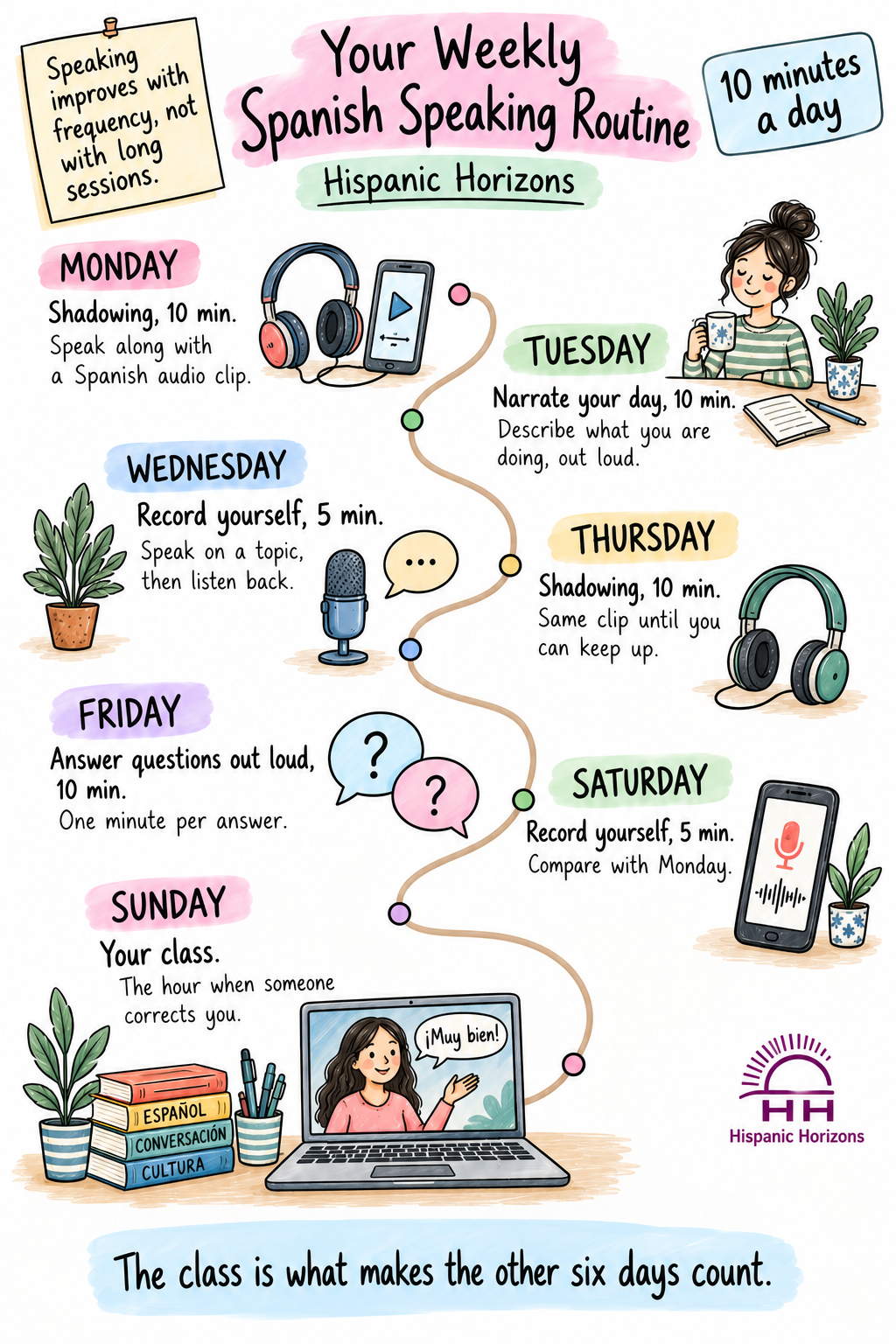
A weekly routine that works
You do not need hours. You need frequency.
- A weekly Spanish class with a teacher. The session where someone hears you and corrects you.
- Daily, 10 minutes: shadowing or narrating your day. Short and every day beats long and occasional.
- Twice a week, 5 minutes: record yourself on a topic and listen back.
Ten minutes a day is about 60 minutes a week of active speaking, on top of your class. Most learners do neither and wonder why speaking is not improving.
The class is the part that makes the other six days count. Without it you are practising but not correcting, and at some point that stops producing progress.
Common mistakes
- Practising only in your head. Thinking in Spanish is useful but it is not speaking. Your mouth needs the training too.
- Starting with material that is too hard. If you cannot follow the audio, you cannot shadow it. Check your Spanish level and pick material just above it.
- Waiting to feel ready. Nobody ever feels ready to speak. The learners who progress are the ones who spoke badly for a few months.
- Stopping to look up every word. Finish the sentence with what you have, then look it up. Fluency is partly the skill of working around the words you do not know.
- Never being corrected. Covered above, and the one that quietly caps your progress.
Frequently asked questions about how to practice Spanish speaking
Can you really learn to speak Spanish without a partner?
You can build fluency, pronunciation and confidence alone, and those are a large part of what speaking is. What you cannot get alone is correction and the unpredictability of real conversation, so regular feedback from a teacher is what turns solo practice into accurate speech.
How much Spanish speaking practice do I need per week?
Around an hour of active practice on your own, split into short daily sessions rather than one long one, plus a weekly class where someone corrects you. Frequency matters more than duration for this skill.
What is shadowing and does it work?
Shadowing is speaking along with a native-speaker recording, a beat behind, copying the rhythm and intonation. It works well for pronunciation and speed, which are physical skills. It does not build spontaneity, so combine it with speaking on your own topics.
Is talking to myself in Spanish actually useful?
Yes, more than most learners expect. It trains word retrieval under time pressure, which is the mechanism that makes conversation feel difficult. It also reveals exactly which everyday vocabulary you are missing, which is useful to take to your next class.
Do language exchange apps work for Spanish conversation practice?
As a complement, a little bit — some give you extra speaking time and some confidence. As a way of learning Spanish, no. Your partner is not trained to correct you, and many of the apps only teach grammar and words out of context. Half the conversation happens in your language, and nobody is guiding what you work on next. Use them alongside structured learning, not instead of it.
Will a self-study course improve my speaking?
Partly. A self-paced course is good for grammar and vocabulary, and it suits disciplined learners revising or moving at their own pace. It cannot listen to you speak, so pair it with a live class and the methods above.
Get the part you can’t do alone
Everything on this page works between classes. None of it replaces the hour a week when someone qualified is listening to you and telling you what to fix.