
If you want to study or work in Germany, learn German — nothing else will do. For almost every other goal, Spanish is the better choice: it is faster to learn for English speakers, spoken across some twenty countries, and in steady demand from employers in India serving Spain and Latin America. The right answer depends on where you want the language to take you.
That is the short version. The rest of this guide explains the differences that actually matter, so you can decide based on your own plans rather than on which language sounds more impressive.
📋 Table of Contents
Spanish vs German at a glance
| Spanish | German | |
|---|---|---|
| Where it is spoken | Spain and most of Latin America | Germany, Austria, Switzerland and neighbours |
| Difficulty for English speakers | Among the easiest | Noticeably harder |
| Pronunciation | Very regular — you read what you see | Regular, but with sounds new to most Indian learners |
| Main grammar hurdle | Verb conjugation, subjunctive | Four cases, three genders, word order |
| Main use from India | Jobs serving Spanish-speaking markets | Study and migration to Germany |
| Official certificates | DELE, SIELE | Goethe-Zertifikat, TestDaF, telc |
Which is easier to learn?
For English speakers, Spanish is easier, and by a clear margin.
The US Foreign Service Institute, which trains American diplomats, groups Spanish with the languages closest to English and estimates roughly 600–750 class hours to reach professional working proficiency. German sits in a harder category, at around 900 hours in its current estimates.
Those figures are for full-time intensive courses, so treat them as a comparison rather than a timetable. The difference comes from three things:
- Spelling and pronunciation. Spanish is written the way it sounds. Once you learn the rules, you can read any word aloud correctly, which makes the first months far less frustrating.
- Grammar. German has four grammatical cases, which change the endings of articles, adjectives and nouns depending on their role in the sentence. Spanish has nothing equivalent. Its hard part is the verb system, especially the subjunctive, and that arrives later — around B1.
- Word order. German sends the verb to the end of many sentences. Spanish word order is flexible and much closer to English.
None of this makes German impossible. It means you should expect to spend more hours to reach the same level, and plan accordingly.
Which is more useful?
This is where the decision really lies, and it depends almost entirely on your goal.
If your goal is Germany
Learn German. Germany has become one of the most popular study destinations for Indian students: DAAD figures put 69,816 Indians at German universities in the winter semester of 2025/26, now the largest group of international students in the country.
Many master’s programmes are taught in English, but daily life, part-time work and most jobs after graduation are not. Germany’s Opportunity Card for skilled workers accepts either A1 German or B2 English as its minimum language requirement, and higher German levels earn extra points in its assessment. In practice, employers outside English-speaking tech teams usually expect B1 or above.
If Germany is the plan, Spanish will not get you there.
If your goal is a job in India
Spanish has the stronger case. IT services, BPO and KPO operations, customer support, market research, logistics and pharma companies in India serve clients in Spain and across Latin America, and they need staff who can work in Spanish. Those roles are based here, not abroad. We looked at who is hiring in Spanish jobs in India.
German-language roles exist in India too, but the larger German opportunity for Indian learners is usually in Germany itself.
If your goal is travel, or you have no fixed plan yet
Spanish opens more doors. It is an official language in some twenty countries, from Spain to Mexico, Colombia, Argentina and Peru, and it is widely spoken in the United States. German is concentrated in Central Europe, where English is also widely understood.
If you are learning a language to broaden your options rather than for one specific destination, Spanish covers more ground.
If your goal is university admission or a scholarship
Check the programme first. Universities in Germany and Austria ask for German certificates; universities in Spain and Latin America, and many exchange programmes, ask for a certified level of Spanish, usually the DELE or the SIELE. Our DELE vs SIELE comparison explains the difference between them.
How long does each one take?
In a regular course of a few hours a week, a realistic picture looks like this:
- Spanish: most learners reach a conversational B1 in about a year of steady classes with practice in between. Our guide to the Spanish language levels explains what each level means in practice.
- German: reaching the same level usually takes longer, because the grammar demands more time before you can speak freely.
Both languages use the same A1 to C2 scale, so a B1 in Spanish and a B1 in German describe the same ability.
Can you learn both?
Yes, but not at the same time if you are a beginner in both. Two new languages at A1 compete for the same space in your head, and progress in each one slows down. The approach that works is to take one to a solid B1 first, then start the second. By that point the first language is stable enough not to interfere.
If you are torn, start with the one tied to your nearest real goal.
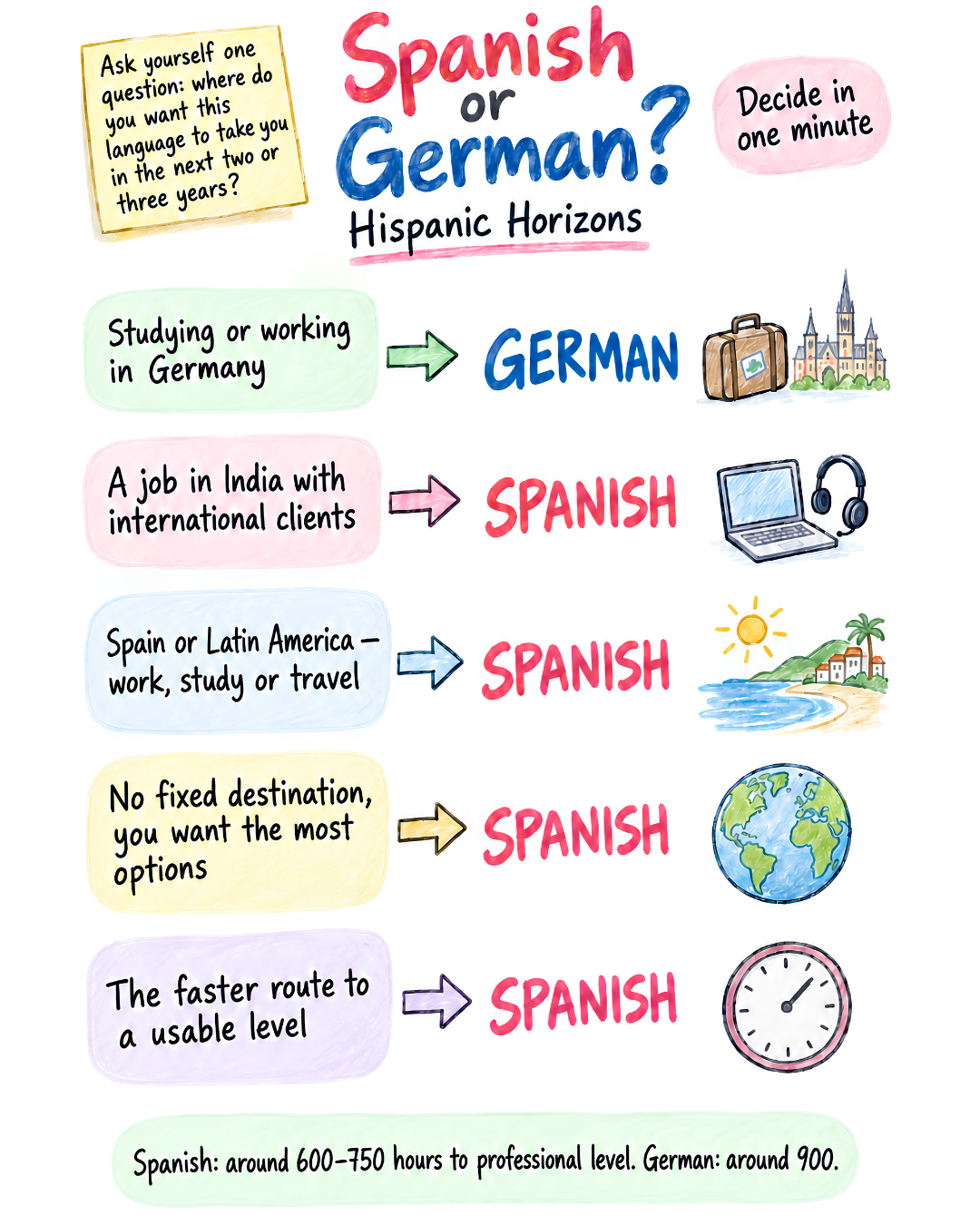
How to decide in one minute
Answer one question: where do you want this language to take you in the next two or three years?
- Studying or working in Germany → German
- A job in India with international clients → Spanish
- Spain or Latin America, for work, study or travel → Spanish
- No fixed destination, you want the most options → Spanish
- You want the faster route to a usable level → Spanish
Learning Spanish with Hispanic Horizons
We teach Spanish only, so take our view on German accordingly — which is exactly why this guide tells you to learn German if Germany is your goal.
If Spanish is the right choice for you, we are an Instituto Cervantes accredited centre and an official DELE and SIELE exam centre. Our courses run from A1 to C2 following the CEFR, in person in Mumbai and through live online Spanish classes for learners anywhere in India. If you are still comparing options, our guide to Spanish classes in India explains what to look for before you enrol.
Frequently asked questions
Is Spanish easier than German?
Yes, for English speakers. Spanish pronunciation is regular, it has no grammatical cases, and its word order is close to English. German has four cases, three genders and verb-final word order, which take longer to master. The US Foreign Service Institute places Spanish in its easiest group and German in a harder one.
Is German or Spanish better for jobs in India?
For jobs based in India, Spanish is usually the stronger choice, because many companies here serve clients in Spain and Latin America. German is more valuable if you plan to move to Germany for work or study.
Do I need German to study in Germany?
Not always for the course itself, since many master’s programmes are taught in English. But you will need German for daily life, part-time work and most jobs after graduation, so learning it before you go makes a real difference.
How many people speak Spanish compared with German?
Spanish has far more speakers. It is the second most spoken native language in the world and an official language in around twenty countries. German is spoken mainly in Germany, Austria and Switzerland.
Can I learn Spanish online in India?
Yes. Live online classes with a teacher follow the same syllabus as a classroom course and give you real speaking practice from anywhere in India.
Which language should I learn first if I want both?
The one linked to your nearest goal. Take it to a solid B1 before starting the second, so the two do not interfere with each other.
Chosen Spanish?
Tell us your goal and your schedule, and we will tell you which level and format to start with.
Live online Spanish classes · Spanish classes in India · Book a trial class