
Nowadays, if you are looking for Spanish classes in India, the choice is confusing: free apps, recorded video courses, private tutors, university departments and language schools all promise the same thing. In practice, what decides whether you end up speaking Spanish is not the price or the platform, it is who teaches you, how much you speak in each class, and whether the course follows a recognised syllabus.
This guide explains the options available to Spamish learners anywhere in India, how the levels work, how long each one realistically takes, what certification you can aim for, and the questions worth asking before you enrol.
📋 Table of Contents
- Why Spanish classes in India are in demand
- The three ways to take Spanish classes in India
- Which level should you start with?
- How long does it take to learn Spanish?
- Spanish classes in India, wherever you live
- Certification: DELE and SIELE from India
- What affects the cost of Spanish classes in India
- A checklist before you book Spanish classes in India
- How to keep improving between classes
- Spanish classes in India: frequently asked questions
- Ready to start Spanish classes in India?
Why Spanish classes in India are in demand
Spanish is, after all, the second most spoken native language in the world and an official language in twenty-one countries, which is why demand for Spanish classes in India keeps growing year after year. For learners here the reasons are concrete rather than abstract:
- Work. IT services, BPO and KPO operations, customer support, market research, logistics and pharma all serve Spanish-speaking markets from India, and employers pay a premium for bilingual roles. We looked at who is hiring in Spanish jobs in India.
- Higher studies. Universities in Spain and Latin America, exchange programmes and scholarships usually ask for a certified level of Spanish.
- Translation and teaching. Freelance translation, interpreting, subtitling and teaching Spanish are viable careers once you reach an advanced level.
- Travel and family. Latin America and Spain become completely different experiences when you can hold a conversation.
- School and college. Many students take Spanish as a second or third language subject and need structured support.
Not sure Spanish is the right language for you? Our guide to Spanish or German compares both for learners in India.
The three ways to take Spanish classes in India
1. Live online classes with a teacher
Usually the most practical option for most people in India. Firstly, you join a scheduled class from home, a real teacher corrects your pronunciation and grammar in the moment, and you speak with classmates instead of repeating after a recording. Besides, there is no commute, and the syllabus matches the classroom one exactly. This is how our live online Spanish classes work, for instance, with batches in Indian Standard Time.
2. In-person classes
If you live in Mumbai, a physical classroom adds something an online class cannot fully replicate: the informal Spanish you pick up before and after class, and the discipline of showing up. Meanwhile, our classroom courses run from our Spanish language school in Mumbai.
3. Self-paced online courses
Typically the cheapest and most flexible option, and the right one if your goal is reading comprehension, exam revision or simply testing whether you enjoy the language. What it cannot give you is correction and conversation, so most learners use a self-paced Spanish course alongside live classes rather than instead of them. Before you choose that route, read can you learn Spanish on your own — it sets out which parts of Spanish respond to solo study and which do not.
| Format | Best for | Main limitation |
|---|---|---|
| Live online with a teacher | Working adults and students anywhere in India who want to speak | You have to commit to a fixed weekly schedule |
| In-person classroom | Learners in Mumbai who prefer face-to-face contact | Travel time and fixed location |
| Self-paced course | Flexible revision, reading, low budget | No live correction or speaking practice |
| Apps only | Vocabulary drills and daily habit | Will not take you to a certified level |
If you are torn between the first two, then compare them in detail in live online vs in-person Spanish classes.
Which level should you start with?
Generally, serious Spanish classes in India follow the CEFR, the Council of Europe framework that divides language ability into six levels. In short, absolute beginners start at A1. If you have studied before, a placement conversation will tell you where you belong, and it is usually lower than people expect, because reading Spanish is far easier than speaking it.
| Level | What you can do at the end of it |
|---|---|
| A1 | Introduce yourself, ask for basic things, handle simple everyday exchanges |
| A2 | Talk about routines, past events, shopping, travel and work in simple terms |
| B1 | Follow a conversation, explain opinions and plans, cope independently while travelling |
| B2 | Discuss topics fluently, use Spanish at work, understand films and news with effort |
| C1 | Work or study in Spanish with ease and express nuance and argument |
| C2 | Handle Spanish at near-native level in academic and professional settings |
For instance, our guide to Spanish language levels from A1 to C2 explains each level with examples.
How long does it take to learn Spanish?
A realistic answer depends on the level and on how much you practise outside class, but as a rule each CEFR level takes somewhere between sixty and a hundred and twenty hours of guided classes, with the higher levels taking longer than the lower ones. In a regular weekly batch that means a few months per level rather than a few weeks.
Typically, learners in India who want to use Spanish at work aim for B1 or B2. Overall, getting to a level where you can hold a real conversation is a matter of a year or so of steady classes, not of a crash course. Consequently, anyone promising fluency in thirty days is selling something else.
Spanish classes in India, wherever you live
Our classroom is in Mumbai, but most of our students are not, and that is the real advantage of online Spanish classes in India. Live online batches run in Indian Standard Time, with weekday evening and weekend options, so learners in Delhi, Bengaluru, Hyderabad, Chennai, Pune, Kolkata, Ahmedabad, Jaipur, Kochi and smaller cities attend the same courses as our Mumbai students, with the same teachers and the same syllabus. In addition, we teach corporate groups and school students in dedicated batches.
Certification: DELE and SIELE from India
Now, if you need proof of your Spanish for a job, a visa or a university, two certificates matter. The DELE is a internarional diploma with lifetime validity from the Instituto Cervantes on behalf of the Spanish Ministry of Education, and you take it on fixed dates for one specific level — the current DELE exam sessions in Mumbai are listed on our exam page. The SIELE is digital, valid for five years, and it grades you on a scale rather than pass or fail, with far more flexible dates.
Which one suits you depends on why you need it, and therefore we break the decision down in DELE vs SIELE. Meanwhile, if you have already decided on the DELE, start with how to prepare for the DELE exam. Preparation matters more than people think, because the exam tests exam technique as much as Spanish. Our accredited Spanish courses, in fact, build directly on these examinations.
What affects the cost of Spanish classes in India
Fees for Spanish classes in India vary enormously, and the cheapest option is rarely the one that gets you to a certificate. Before comparing numbers, therefore, check what the fee actually covers:
- Firstly, whether it is a group batch or one-to-one teaching
- Secondly, how many hours the course includes, and how many weeks it runs
- Thirdly, whether the teacher holds a qualification to teach Spanish as a foreign language
- Accreditation: does a recognised body accredit the centre, and which one
- Books and materials: does the fee include them
- Exam fees, which you pay separately to the examination body: included or not
- Make-up classes, in case you miss one
Finally, for current course options and fees, get in touch with us and tell us your level and your goal.
A checklist before you book Spanish classes in India
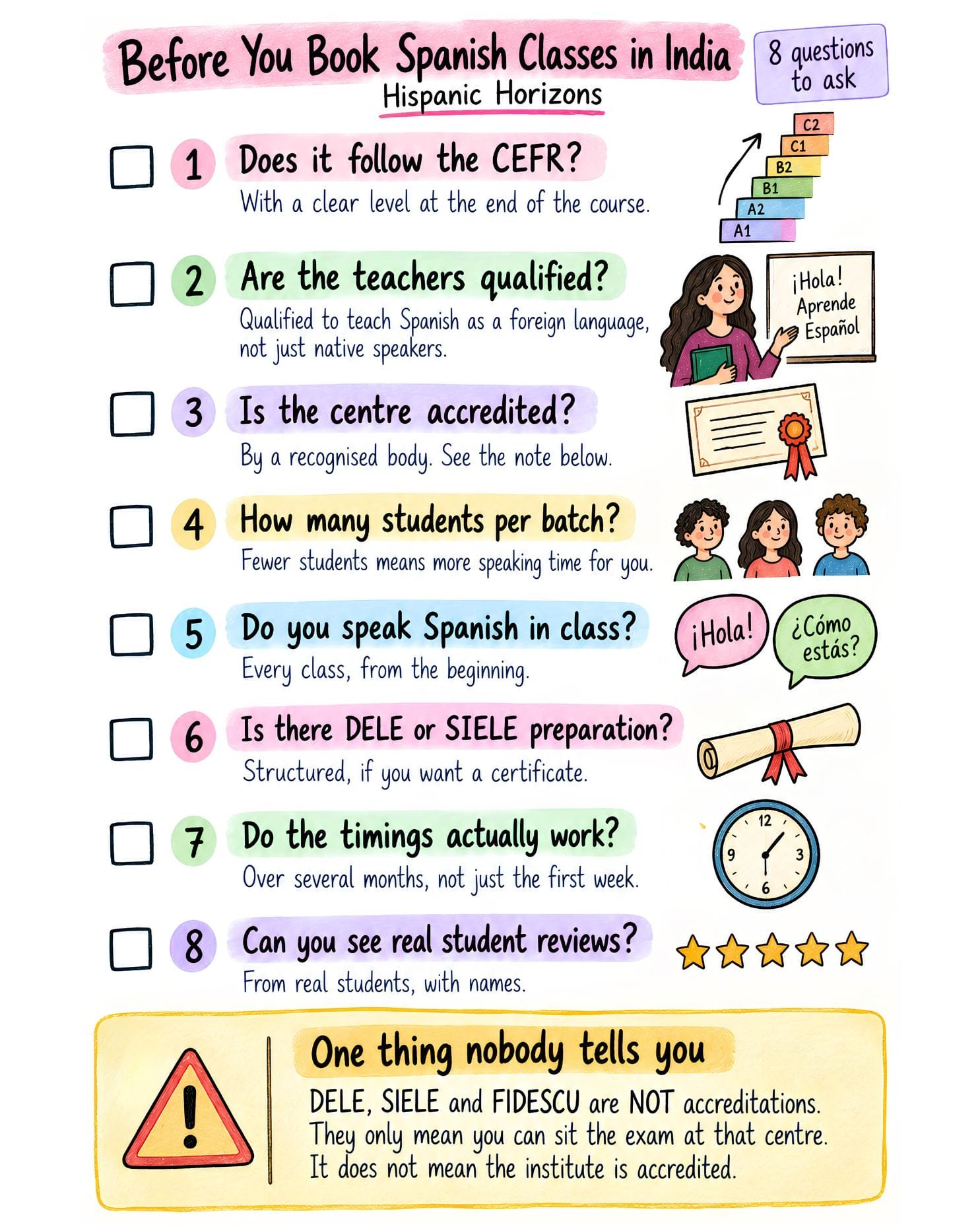
- Does the course follow the CEFR, with a clear level at the end of it?
- Are the teachers qualified to teach Spanish as a foreign language?
- Has a recognised body accredited the centre? Please keep in mind that DELE, SIELE and FIDESCU are not acreditations. They mean you can take DELE, SIELE or DIE in that center. This does not mean the institute is acredited.
- How many students are there per batch, and how much will you actually speak?
- Do they speak Spanish in the class and they practice converation in class everyday?
- Is there structured preparation for the DELE or SIELE if you want it?
- Are the timings realistic for your work or college schedule over several months?
- Can you see reviews from real students, such as our student reviews and testimonials?
How to keep improving between classes
Still, two or three hours of class a week will not do the job on their own. By contrast, twenty focused minutes a day changes everything: listening to podcasts at your level, narrating your own day out loud, reading short news pieces, keeping a vocabulary notebook you actually revisit. Additionally, if you have nobody around to talk to, our guide on how to practise speaking Spanish on your own has the routines we recommend to our students.
Spanish classes in India, at Hispanic Horizons: frequently asked questions
Can I learn Spanish online in India with a live teacher?
Yes. At Hispanic Horizons, our live online Spanish classes in India run follow the same syllabus as classroom courses, with a teacher helping you in real time.
Do I need any previous knowledge of Spanish to start level 1 at Hispanic Horizons?
No. Our A1 courses start from zero, so absolute beginners fit in perfectly. If you have studied before, a short placement conversation will place you in the right level.
Are the classes taught in Spanish?
At the beginning in Level 1, teachers explain few things in English, and the amount of Spanish increases as you progress, and classes run entirely in Spanish at the higher levels from level A2.
How long does it take to become conversational?
Most learners can hold a real conversation around B1, which in a steady weekly batch usually means around a year of classes with regular practice in between.
Is Spanish actually useful for jobs in India?
Yes, particularly in IT services, BPO and KPO operations, market research, travel and translation. In fact, we cover the detail in our article on Spanish jobs in India.
Do you teach students outside Mumbai?
Yes. Indeed, many of our online students at Hispanic Horizons live outside Mumbai, across India and abroad.
Will I get a certificate at the end of the course?
You receive a course certificate with international prestige for the level you complete, and our Spanish classes also prepare you for the official DELE or SIELE examinations.
Ready to start Spanish classes in India?
So, if you already know you want live teaching, look at our live online Spanish classes or face to face. If you are still unsure which level or format of Spanish classes in India fits you, write to us with your goal and your availability, and we will tell you where to start.